2009
NS3377 : Seaweed - Ascophyllum nodosum, Vertebrata lanosa
taken 15 years ago, near to Geilston, Argyll And Bute, Scotland
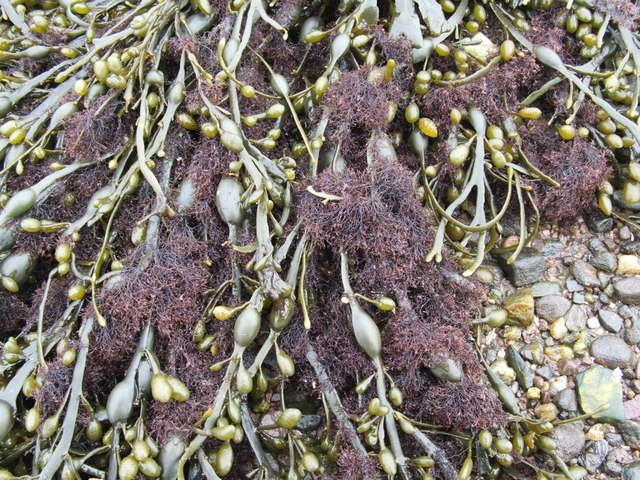
Seaweed - Ascophyllum nodosum, Vertebrata lanosa
The seaweed with the large olive-green fronds is Knotted Wrack, Ascophyllum nodosum; this species is one of the Brown Algae (Class Phaeophyceae). It is a common and relatively long-lived species of the middle shore, but prefers fairly sheltered rocky habitats (if it is present at all in very exposed sites, then it tends to be rather stunted).
[As the preferred habitat of this species suggests, this is indeed a very rocky area of the shore – see NS3376 : Geilston Yair, taken from a point less than 70 metres away.]
In this species, the stem lacks a central midrib, but incorporates air-bladders at regular intervals; they are visible here as large swellings. Also shown are smaller, more yellowish structures, borne on side branches; although similar to them in shape, these are not air-bladders, but are reproductive structures. This is a dioecious species (i.e. there are separate male and female plants), and the reproductive structures, which have a rougher surface than the air-bladders, are yellow in the male, and greenish in the female.
A number of purple-red filamentous tufts are also visible in the photograph. This is another species of seaweed, called Vertebrata lanosa (syn. Polysiphonia lanosa); it is one of the Red Algae (Class Rhodophyceae). It is not merely growing among the Knotted Wrack, but is growing on it; it does so by means of root-like structures called rhizoids, which penetrate the tissues of its host. This species is most commonly found growing on Knotted Wrack, and is likely to appear wherever its host is common; it may also grow, though more rarely, on wracks of the genus Fucus.
[As the preferred habitat of this species suggests, this is indeed a very rocky area of the shore – see NS3376 : Geilston Yair, taken from a point less than 70 metres away.]
In this species, the stem lacks a central midrib, but incorporates air-bladders at regular intervals; they are visible here as large swellings. Also shown are smaller, more yellowish structures, borne on side branches; although similar to them in shape, these are not air-bladders, but are reproductive structures. This is a dioecious species (i.e. there are separate male and female plants), and the reproductive structures, which have a rougher surface than the air-bladders, are yellow in the male, and greenish in the female.
A number of purple-red filamentous tufts are also visible in the photograph. This is another species of seaweed, called Vertebrata lanosa (syn. Polysiphonia lanosa); it is one of the Red Algae (Class Rhodophyceae). It is not merely growing among the Knotted Wrack, but is growing on it; it does so by means of root-like structures called rhizoids, which penetrate the tissues of its host. This species is most commonly found growing on Knotted Wrack, and is likely to appear wherever its host is common; it may also grow, though more rarely, on wracks of the genus Fucus.
![Creative Commons Licence [Some Rights Reserved]](https://s1.geograph.org.uk/img/somerights20.gif)


TIP: Click the map for more Large scale mapping
- Grid Square
- NS3377, 57 images (more nearby 🔍)
- Photographer
- Lairich Rig (more nearby)
- Date Taken
- Wednesday, 18 February, 2009 (more nearby)
- Submitted
- Thursday, 19 February, 2009
- Subject Location
-
OSGB36:
 NS 3371 7705 [10m precision]
WGS84: 55:57.4559N 4:39.9132W - Camera Location
-
OSGB36: NS 3371 7705
- View Direction
- EAST (about 90 degrees)


