Woodland of the Black Isle


Contents
- Introduction to the Black Isle
- How to best use this article
- Black Isle Woods promoted by the Woodland Trust
- Exceptional Woods - Sites of Special Scientific Interest (SSSI)
- Special Woods - Woodlands of Significant Conservation Interest
- One hundred Black Isle Woods waiting to be explored
- Lifetime and age of woods
- My favourite Black Isle woods
- Comprehensive catalogue by region
- Avoch and Killen
- Conon Bridge
- Contin - beyond the Black Isle
- Cromarty
- Dingwall - beyond the Black Isle
- Ferintosh
- Fortrose and Rosemarkie
- Garve
- Killearnan
- Knockbain
- Marybank, Scatwell and Strathconon - beyond the Black Isle
- Maryburgh - beyond the Black Isle
- Muir of Ord - within the Black Isle
- Muir of Ord - beyond the Black Isle
- Resolis
- Strathpeffer - beyond the Black Isle
- Acknowledgements
Fortrose and Rosemarkie

Arabella Croft Woodlands

A quite unnatural place. A set-piece for geomorphologists studying glacial and fluvial erosion. Also A Site of Special Scientific Interest all hidden away and seen from footpaths kindly created by the landowner.
by Julian Paren
Blackstand Wood

As enjoyed on a cold, frosty and foggy day.
by Julian Paren
Blackstand, Former Forestry Commission Nursery

The owner created some paths when the area was cleared of sitka and replaced by deciduous trees.
by Julian Paren
Burnside Wood

A shelter bed of trees alongside the Killen road which backs onto fields below the main forestry plantation of the Black Isle.
by Julian Paren
Callachy Hill
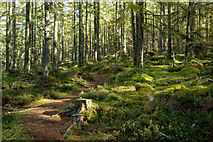
The Hill Climb and its Downhill partner are described thus by Forestry and Land Scotland
Two blue gems that take you easily uphill and dizzyingly down again. You can tackle these trails as two separate routes, or together. The Callachy Hill Climb (1 mile /1.6 km) winds uphill through tall larch trees that are emerald green in spring and gorgeous orange in autumn, getting you to the top of the hill without
too much muscle strain. From there you can try the Bike Park or continue on to the Callachy Downhill (3/4 mile / 1.2 km) - a sheer, spiralling, downhill delight!
by Julian Paren
Fairy Glen

The most impressive part of the Fairy Glen is the steep sided section below the waterfalls. It seems to be in perpetual shadow in the late autumn/early winter when the foliage colours are at their best. This visit was during late afternoon on a cloudy November day but still produced the wow factor. Fairy Glen is a RSPB Reserve noted for the colour of its Norway Maple in the autumn.
by Julian Paren
Woodland Trust website says: This is a steep-sided wooded glen with a fast running stream running through it and waterfalls. Plenty of spring woodland flowers. Look for grey wagtails, dippers and buzzards and plentiful woodland birds. There is a millpond with summer dragonflies.
by Julian Paren
Woodland Trust website says: This is a steep-sided wooded glen with a fast running stream running through it and waterfalls. Plenty of spring woodland flowers. Look for grey wagtails, dippers and buzzards and plentiful woodland birds. There is a millpond with summer dragonflies.
Feddanhill Wood

The 35-acre wood is privately owned but visitors are welcomed. The Scottish Wildlife Trust organised the day's visit and the owner spent five hours with us. There are well-drained footpaths everywhere.
by Julian Paren
The Woodland Trust website says: Feddanhill Wood is a lovely small woodland, with car park, located on the outskirts of the delightful town of Fortrose on the Black Isle. The woods offer a mix of gradients, with some great natural sculpture art. There are outstanding views from each side of the wood. One side provides views of the mighty Ben Wyvis; while the other offers a sweeping panoramic down to the Moray Firth across Chanonry Point and out to Fort George - an area famous for its resident bottlenose dolphins and grey seals.
Flowerburn Wood

The wood is fairly dense and has a good track through it used by walkers and horses. This section of path in the wood is not on OS mapping.
by Julian Paren
Hillockhead Farm Woodland - SSSI

A recently created path stays near the edge of the ravine and passes through Silver Birch woodland with Granny Scots Pine.
by Julian Paren
Upland birch woodland
This site contains the only representation of coastal cliff woodland in the Inner Moray Firth. The relative shelter of this area allows oak-hazel woodland in particular to be well represented and occurring in sheltered hollows throughout the site. Larger remnants of this type of woodland, which includes oak, ash, wych elm and hazel, remain in some deep gullies and gorges such as Brownhill and Eathie. The woodland on the upper margins reflect species more tolerant of acid conditions such as birch, rowan and Scots pine. This site provides the only Easter Ross location for the nationally scarce tree, rock whitebeam, (Sorbus rupicola). Purple mountain milk-vetch (Oxytropis halleri). The nationally rare purple mountain milk-vetch occurs at three locations in the site. The plants occur on steep, unstable, well drained ground where there is little competition from other species.
For further information about the Rosemarkie to Shandwick SSSI, which includes this wood, visit the relevant page of my article on the Black Isle's Sites of Special Scientific Interest Link
Hill of Fortrose also named Viewmount Wood

All attempts to enter Viewmount Wood failed. The electrified fence was the most serious hazard. However I could find little weakness in the wood's boundary. The natural access is barred by an over-high locked gate and tall fencing. I do wonder if the security is linked to another area of the wood, marked as continuous deciduous woodland on OS Mapping, that contains buildings and cars hidden in the centre of the wood. Such is seen from today's aerial imagery. All very strange. The site is at NH 717574.
by Julian Paren
Millbuie and Findon Forest
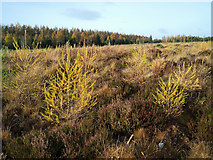
An open area close to the B9160 with the larch growing up within the heather.
by Julian Paren
Raddery Burn - CI Grade 2

Raddery Wood is owned by Highland Council who wish to sell it. Currently there is an application for a Community Asset Transfer for the wood, with a deadline extended to 30 November 2022. It will be interesting to see how the wood might develop and who its owners might be.
by Julian Paren
Ravine with ash/wych elm and valley alderwood, birch/rowan on upper slopes
Size: 4ha
Geology: Boulder clay on Old Red Sandstone.
Soils: Brown forest soils, mostly freely drained with some wet areas.
Habitats: Steep sided ravine with fast flowing stream. Dead wood.
Woodland Types: 1D Ash/wych elm. 7A Valley alderwood. 12A Birch with rowan.
Description
The wood has two distinct areas, the higher ground outwith the ravine, which is more acidic and dominated by birch, and the ravine itself, which is more basic and contains stand types 7A and 1B. The birchwood area contains a substantial amount of willow (Salix aurita, S. caprea and S. cinerea) and has an under-storey dominated by Luzula sylvatica, with mosses (mainly Rhytidiadelphus triquetrus and Hylocomium splendens); Ajuga, Oxalis, Deschampsia flexuosa, Fragaria and Pteridium. Trientalis is frequent in this area, and Pyrola present in a number of locations.
In the lower parts of the valley, alder predominates, with ash, hazel and elm. Angelica, Geum spp and Juncus effusus dominate the herb layer. Along the sides of the ravine, which are steep in places, the woodland is a mixture of planted and naturally occurring species, with wych elm, ash, oak and hazel as the main natural communities, with birch and willow. Beech and oak are the main planted species, although it is not possible to differentiate completely between introduced and natural stock.
Regeneration is plentiful. The herb layer under this section of the wood is dominated by Luzula sylvatica, with abundant fern growth (mostly Athyrium filix-femina) and Lonicera, Holcus spp, Oxalis, Viola spp and Veronica spp.
Species of Note: Pyrola minor
Land Use Pressures: None apparent, except for an excessive rabbit population.
Adjacent Land: Arable and grazing.
CI Grade 2
( Page < < prev 1 ... 9 10 11 12 13 14 15 16 17 18 19 20 21 ... next >> )
