SJ8496 : Islamic Academy
taken 15 years ago, near to Manchester, England
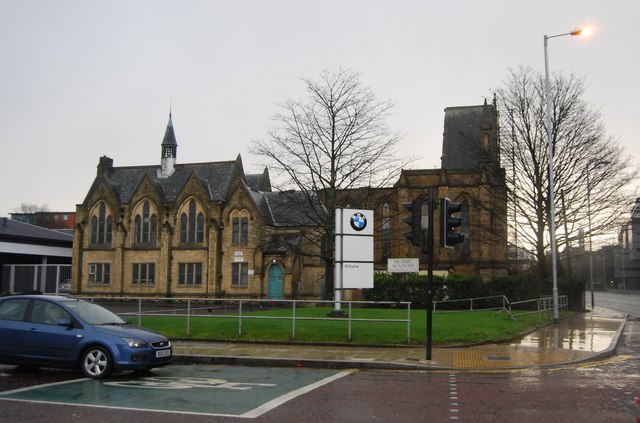

The Unitarian Chapel, Upper Brook Street, Manchester, a Grade II* listed building, was described by the Victorian Society in 2010 Link
as one of the ten most endangered Victorian buildings in England & Wales
The former Unitarian Chapel has been owned by Manchester City Council since the 1970s. Opened in 1839 it is the first known example of a Gothic nonconformist chapel and believed to have been an early collaboration between Sir Charles Barry and AWN Pugin before they worked together on the Palace of Westminster. Yet despite its national significance, the chapel has been neglected for decades, resulting in 2005 in the removal of its roof. The chapel is now open to the elements and largely a ruin.
It was constructed between 1837 and 1839 out of sandstone, with a slate roof. It is in English neogothic style. The building has seven narrow bays, with buttresses and a lancet in each bay. The west end has a giant moulded archway, with an arched doorway at the ground floor with a window above. On the east end there is a rose window. The corners are square, with pinnacles. The inside of the chapel had galleries on three sides, and a ribbed, vaulted ceiling. The attached two-storey Sunday School is in the same style as the chapel, and has a triple-gabled north side, with large arched windows on the first floor. It also has a canted apse on the west end, and a lean-to porch.
The chapel was originally constructed for the Unitarians and was used for burial rites until at least 1857 (although the chapel has no graveyard), as well as baptisms until at least 1912, and marriages until at least 1916.
The chapel was sold in 1928 and subsequently used as a Welsh Baptist Chapel. It was then used as a Jehovah's Witnesses Kingdom Hall in the early 1970s. The most recent use of both the chapel and former Sunday School was for the Islamic Academy of Manchester between 1974 and 2006, when it was used as a mosque, teaching centre and for outreach work in the Asian community. In 2010 the chapel was vacant, whilst the Islamic Academy still occupied the Sunday School.
More information and photos on Wikipedia: Link
Update, December 2017: Both chapel and Sunday school have now been converted into student accommodation Link
Listed buildings and structures are officially designated as being of special architectural, historical or cultural significance. There are over half a million listed structures in the United Kingdom, covered by around 375,000 listings.
Listed status is more commonly associated with buildings or groups of buildings, however it can cover many other structures, including bridges, headstones, steps, ponds, monuments, walls, phone boxes, wrecks, parks, and heritage sites, and in more recent times a road crossing (Abbey Road) and graffiti art (Banksy 'Spy-booth') have been included.
In England and Wales there are three main listing designations;
Grade I (2.5%) - exceptional interest, sometimes considered to be internationally important.
Grade II* (5.5%) - particularly important buildings of more than special interest.
Grade II (92%) - nationally important and of special interest.
There are also locally listed structures (at the discretion of local authorities) using A, B and C designations.
In Scotland three classifications are also used but the criteria are different. There are around 47,500 Listed buildings.
Category A (8%)- generally equivalent to Grade I and II* in England and Wales
Category B (51%)- this appears generally to cover the ground of Grade II, recognising national importance.
Category C (41%)- buildings of local importance, probably with some overlap with English Grade II.
In Northern Ireland the criteria are similar to Scotland, but the classifications are:
Grade A (2.3%)
Grade B+ (4.7%)
Grade B (93%)
Read more at Wikipedia Link


- Grid Square
- SJ8496, 304 images (more nearby 🔍)
- Photographer
- N Chadwick (more nearby)
- Date Taken
- Saturday, 17 December, 2011 (more nearby)
- Submitted
- Sunday, 8 April, 2012
- Subject Location
-
OSGB36:
 SJ 8475 9697
[10m precision]
WGS84: 53:28.1546N 2:13.8718W - Camera Location
-
OSGB36:
SJ 8470 9699
- View Direction
- East-southeast (about 112 degrees)


