SK4553 : Church of St Helen, Selston
taken 12 years ago, near to Selston, Nottinghamshire, England
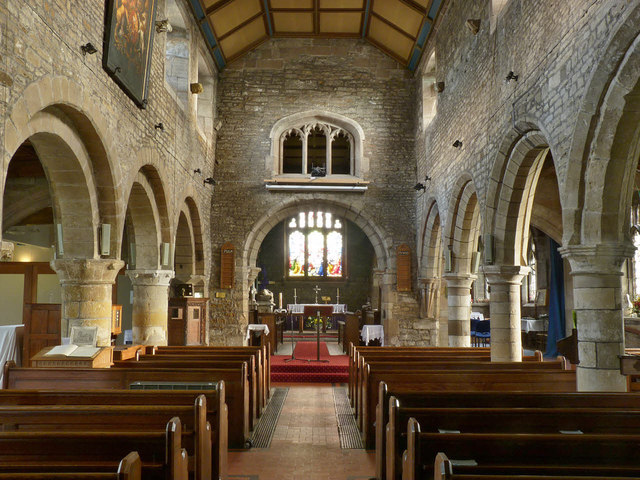

The church consists of nave and chancel with north and south aisles, west tower and south porch. A modern community facility was added to the north side in 2011. The external aspect of the church is principally determined by the 19th and 20th century restorations, only the tower and porch remaining relatively original. The north aisle was built in 1905, replacing an earlier aisle as indicated by the late 12th century arcade.
The 'restored' external impression is not continued inside. On entering from the south door, there is an immediate impact from the Norman aisle arcades. The northern arcade is the earlier, of 4 semi-circular arches dating probably from the late 12th century, with interesting waterleaf and gargoyle capitals. The south arcade is slightly later 13th century, more Transitional in style with plain moulded capitals but still with round columns and round arches. The columns of the two arcades are not aligned with each other across the nave. Above the arcades are a series of grotesque corbels which would have supported the earlier roof beams.
The chancel arch and the arcades between chancel and aisles are also of similar period, with semicircular arches. Fenestration throughout dates from the various restorations, in a mixture of 13th and 15th century styles.
The tower is late 14th century, in Perpendicular style. The south porch is 13th century, in Early English style, the south door being slightly earlier, still displaying a semicircular arch of 3 plain orders.
Of interior fittings, only three significant items predate the 19th century restorations. These are the font, the Willoughby Monument and the royal coat of arms. The font is Norman in origin and has had a varied history. Removed from the church during the Commonwealth period, it was used as a drinking trough and a butchers' whetstone before being rescued from a local pub by the then Vicar, the Rev. Charles Harrison, in the early 20th century. The Willoughby Monument is a fine piece of early 17th century work consisting of a chest tomb with the effigies of William Willoughby (d.1630) and his wife Elizabeth, surmounted by a pillared half canopy in classical Jacobean style, topped with the family coat of arms. The royal coat of arms is undated but is recorded as dating from 1815. It is hung above the north aisle arcade.
The church is Listed Grade II*. For more information about the church see the Southwell & Nottingham Church History Project Link.
Listed buildings and structures are officially designated as being of special architectural, historical or cultural significance. There are over half a million listed structures in the United Kingdom, covered by around 375,000 listings.
Listed status is more commonly associated with buildings or groups of buildings, however it can cover many other structures, including bridges, headstones, steps, ponds, monuments, walls, phone boxes, wrecks, parks, and heritage sites, and in more recent times a road crossing (Abbey Road) and graffiti art (Banksy 'Spy-booth') have been included.
In England and Wales there are three main listing designations;
Grade I (2.5%) - exceptional interest, sometimes considered to be internationally important.
Grade II* (5.5%) - particularly important buildings of more than special interest.
Grade II (92%) - nationally important and of special interest.
There are also locally listed structures (at the discretion of local authorities) using A, B and C designations.
In Scotland three classifications are also used but the criteria are different. There are around 47,500 Listed buildings.
Category A (8%)- generally equivalent to Grade I and II* in England and Wales
Category B (51%)- this appears generally to cover the ground of Grade II, recognising national importance.
Category C (41%)- buildings of local importance, probably with some overlap with English Grade II.
In Northern Ireland the criteria are similar to Scotland, but the classifications are:
Grade A (2.3%)
Grade B+ (4.7%)
Grade B (93%)
Read more at Wikipedia Link


- Grid Square
- SK4553, 38 images (more nearby 🔍)
- Photographer
- Alan Murray-Rust (more nearby)
- Date Taken
- Sunday, 30 November, 2014 (more nearby)
- Submitted
- Tuesday, 2 December, 2014
- Subject Location
-
OSGB36:
 SK 4583 5330
[10m precision]
WGS84: 53:4.4983N 1:19.0426W - Camera Location
-
OSGB36:
SK 4583 5330
- View Direction
- EAST (about 90 degrees)


