TL4559 : Corpus Christi and Sidney Sussex Boathouse
taken 9 years ago, near to Cambridge, Cambridgeshire, England
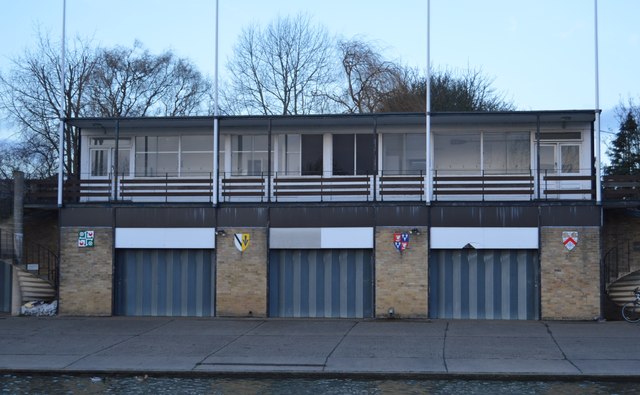
either side, with newel posts and a steel balustrade.
The deeper ground floor provides a three bay boat store, with lean-to extensions and a pitched roof. The doors are of concertina style. On the front of the buildingare the four crests of the Colleges sharing the boathouse,
and four flagpoles: Corpus Christi; Girton; Sidney Sussex; and Wolfson.
The college boat houses are along the River Cam, downstream of Victoria Bridge.
Rowing first started at Cambridge in 1825, before it was introduced at Oxford. The first College boat club established was St. Johns, closely followed by Trinity. By 1830 Jesus, Magdalene, Emmanuel, Christ’s, Corpus Christi and Peterhouse Colleges had also founded boat clubs, and by 1835 a total of fifteen Colleges had them. Newnham ladies founded the first women’s boat club in 1896.
The first College boathouse was built for Trinity in 1872, and by the end of the nineteenth century most of the Colleges had built, or started to build, boathouses of their own.
Corpus Christi College (full name: The College of Corpus Christi and the Blessed Virgin Mary, often shortened to "Corpus", or previously sometimes "The Body") is a constituent college of the University of Cambridge. It is notable as the only college founded by Cambridge townspeople: it was established in 1352 by the Guilds of Corpus Christi and the Blessed Virgin Mary, making it the sixth-oldest college in Cambridge. With around 500 students and fellows, it is also the second smallest of the traditional colleges of the University (after Peterhouse), and the smallest in terms of undergraduate student intake.
Grade I listed. Link
Wikipedia: Link
Sidney Sussex College (referred to informally as "Sidney") is a constituent college of the University of Cambridge.
The college was founded in 1596 and named after its foundress, Frances Sidney, Countess of Sussex. It was from its inception an avowedly Puritan foundation: some good and godlie moniment for the mainteynance of good learninge. Oliver Cromwell was among the first students (although his father became ill and he never graduated), and his head is now buried beneath the College's Ante-Chapel.
The main part of the college is Grade I listed. Link
Website: Link
Wikipedia: Link
Girton College is one of the constituent colleges of the University of Cambridge. It was England's first residential college for women, established in 1869 by Emily Davies, Barbara Bodichon and Lady Stanley of Alderley. The full college status was only received in 1948 and marked the official admittance of women to the university. In 1976, it was Cambridge's first women's college to become coeducational.
The main college site, situated on the outskirts of the village of Girton about 2.5 miles northwest of the university town, comprises 33 acres of land. Held in typical Victorian red brick design, most was built by architect Alfred Waterhouse between 1872 and 1887.
Wikipedia: Link
Website: Link
Wolfson College is a constituent college of the University of Cambridge. Wolfson is one of a small number of Cambridge colleges which admit only students over the age of 21. The majority of students at the college are postgraduates, with around 15% studying undergraduate degree courses at the university. The college was founded in 1965 as "University College", and changed its name to Wolfson College in 1973 in recognition of the benefaction of the Wolfson Foundation. Wolfson is located to west of Cambridge city centre, near the University Library. Wolfson was the first college in Cambridge to admit men and women as both students and Fellows.
Wikipedia: Link
website: Link
The architect was Michael Mennim of York.
As one of the more modern colleges in Cambridge, Wolfson does not follow all of the traditions of some of the University's older colleges. For example, since the college's founding there has been no "High Table" reserved for Fellows at Formal Hall dinners; students and Fellows mix and dine together, although the tradition of wearing academic gowns to such occasions is still preserved. Both Fellows and students at the college have access to all the facilities. With students from over 70 countries, Wolfson claims to be one of Cambridge's most cosmopolitan colleges.
Listed buildings and structures are officially designated as being of special architectural, historical or cultural significance. There are over half a million listed structures in the United Kingdom, covered by around 375,000 listings.
Listed status is more commonly associated with buildings or groups of buildings, however it can cover many other structures, including bridges, headstones, steps, ponds, monuments, walls, phone boxes, wrecks, parks, and heritage sites, and in more recent times a road crossing (Abbey Road) and graffiti art (Banksy 'Spy-booth') have been included.
In England and Wales there are three main listing designations;
Grade I (2.5%) - exceptional interest, sometimes considered to be internationally important.
Grade II* (5.5%) - particularly important buildings of more than special interest.
Grade II (92%) - nationally important and of special interest.
There are also locally listed structures (at the discretion of local authorities) using A, B and C designations.
In Scotland three classifications are also used but the criteria are different. There are around 47,500 Listed buildings.
Category A (8%)- generally equivalent to Grade I and II* in England and Wales
Category B (51%)- this appears generally to cover the ground of Grade II, recognising national importance.
Category C (41%)- buildings of local importance, probably with some overlap with English Grade II.
In Northern Ireland the criteria are similar to Scotland, but the classifications are:
Grade A (2.3%)
Grade B+ (4.7%)
Grade B (93%)
Read more at Wikipedia Link
![Creative Commons Licence [Some Rights Reserved]](https://s1.geograph.org.uk/img/somerights20.gif)


- Grid Square
- TL4559, 1309 images (more nearby 🔍)
- Photographer
- N Chadwick (more nearby)
- Date Taken
- Saturday, 10 January, 2015 (more nearby)
- Submitted
- Sunday, 8 February, 2015
- Subject Location
-
OSGB36:
 TL 4575 5910 [10m precision]
WGS84: 52:12.6509N 0:7.9049E - Camera Location
-
OSGB36: TL 4573 5905
- View Direction
- North-northeast (about 22 degrees)


