NT2574 : Statue of James Clerk Maxwell, George Street Edinburgh
taken 7 years ago, near to Edinburgh, Scotland
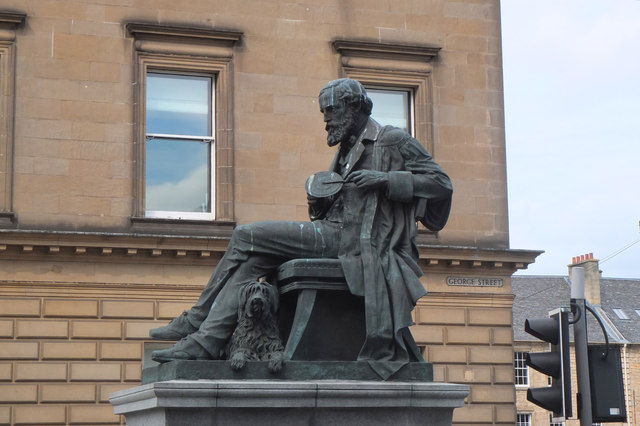
He made far-reaching contributions to science, culminating in his synthesis of electricity and magnetism that paved the way for Einstein's theory of special relativity. He became Professor of Experimental Physics at the University of Cambridge in 1871 and a road to the new West Cambridge site and new Cavendish Laboratory is named after him: TL4359 : Clerk Maxwell Road, West Cambridge.
Maxwell (1831 – 1879) was born in Edinburgh, at 14 India Street, but spent his early years at Glenlair NX7572 : Glenlair House, the family estate in Galloway; his uncle was Sir George Clerk, baronet, of Penicuik House NT2159 : Penicuik House Project.
Maxwell’s work covered a wide area of physics, including the dynamics of Saturn’s rings and significant advances in the theory of heat and thermodynamics. In 1861 he showed the world’s first colour photograph at the Royal Institution.
His greatest scientific achievement lay in the synthesis of electricity and magnetism, showing the possibility of electromagnetic waves, of which light was the prime example. The celebrated Maxwell Equations encapsulate all electromagnetic phenomena in a few lines.
For a biography, see ‘The Man Who Changed Everything’ by Basil Mahon, Wiley 2003.


- Grid Square
- NT2574, 1831 images (more nearby 🔍)
- Photographer
- Jim Barton (more nearby)
- Date Taken
- Friday, 23 August, 2019 (more nearby)
- Submitted
- Wednesday, 28 August, 2019
- Subject Location
-
OSGB36:
 NT 2549 7407
[10m precision]
WGS84: 55:57.2313N 3:11.6903W - Camera Location
-
OSGB36:
NT 2549 7407
- View Direction
- North-northeast (about 22 degrees)


